
Morning Brief | Mar. 18, 2026
Good morning, and welcome back to CLEARING HOUSE. Happy Fed Day to those who celebrate.
Global markets are entering the Federal Reserve’s March decision day with a fragile sense of calm. US equities are looking for their third-straight day of gains after weeks of volatility, oil prices have paused rather than accelerated, and bond yields are drifting modestly lower even as the war in Iran continues to disrupt the global energy system. The resulting signal set reflects a market testing whether the worst of the initial tightening impulse may already be priced in — even as policymakers prepare to navigate a shock whose duration and transmission remain deeply uncertain.
Today’s Fed decision will not resolve that tension. Instead, it is likely to sharpen the central question confronting investors: whether sustained energy friction will force central banks to keep financial conditions tighter for longer than previously assumed.
MARKET READOUT (7:24 a.m. ET)
US 2-year, 10-year: -0.6bps / -2.1bps
DXY: -0.06% | USD/JPY: -0.03% | USD/CNH:-0.13%
S&P Futures: +0.46% | Euro Stoxx: +1.04%
Nikkei: +2.87% at close | Kospi: +5.04% at close | Hang Seng: +0.61% at close
Brent, WTI: +0.02% ($103.44) / -1.7% ($93.91) | Copper: -0.74% | Gold: -0.83%
VIX: 21.76 (-0.62)
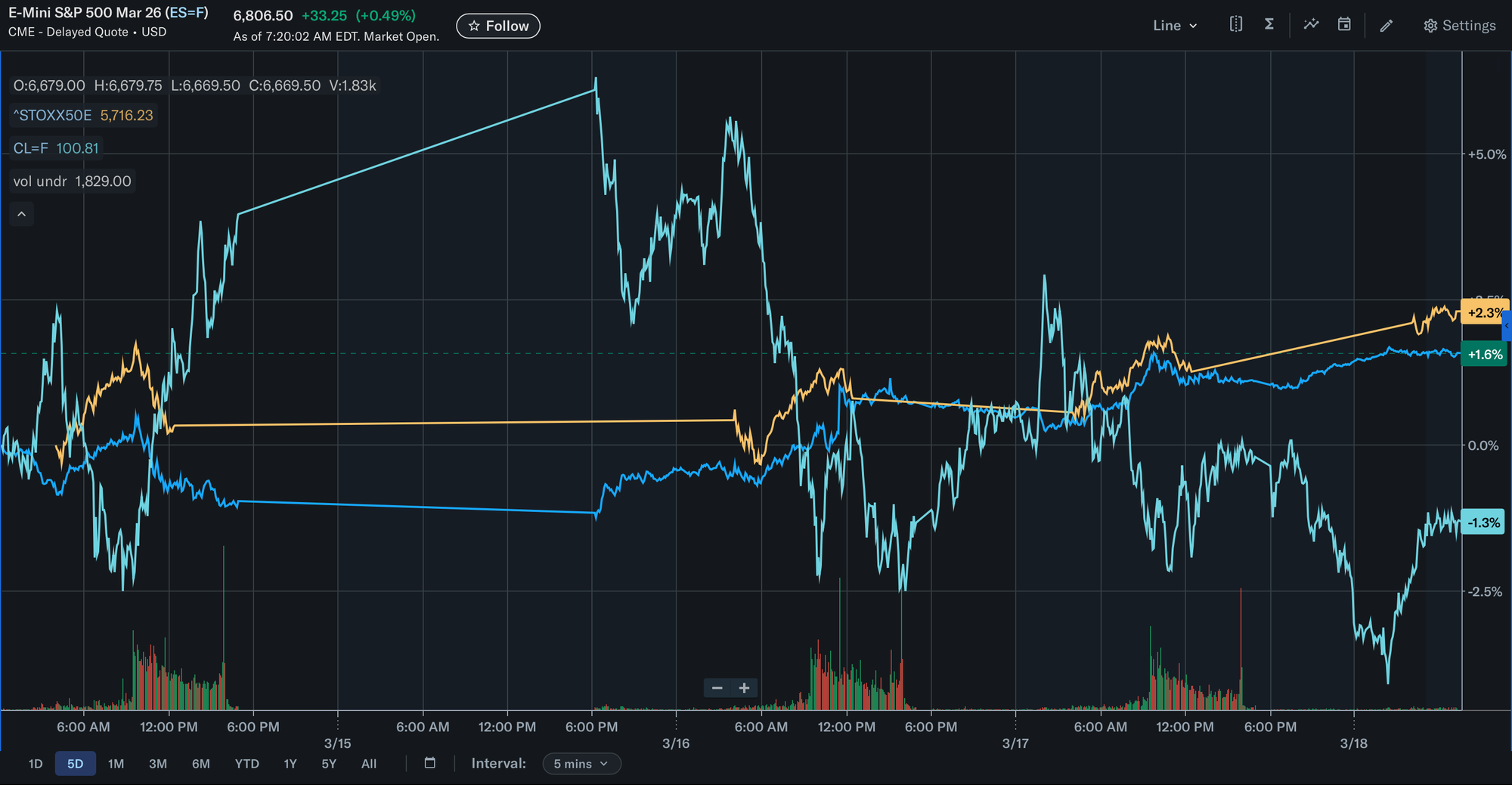
MOVING THE TAPE
Markets stabilize ahead of the Federal Reserve decision.
Global equities are rebounding, with US futures pointing to a third consecutive day of gains and Asian benchmarks rallying sharply. The move reflects a tentative reassessment of near-term escalation risks as investors await policy guidance from central banks — the Fed, the ECB, the BOE, the BOJ, and others — this week.
Iraq resumes pipeline exports, offering marginal supply relief.
Baghdad has restarted crude shipments through the northern pipeline to Turkey’s Mediterranean port of Ceyhan after reaching an agreement with the Kurdistan Regional Government. While flows are expected to remain well below pre-war levels, the development underscores how producers are looking for alternative routes to export their oil as tanker traffic through the Strait of Hormuz remains constrained.
Central banks enter a decisive policy cluster.
The Federal Reserve’s decision today will be followed by rate announcements from the European Central Bank and the Bank of England, with additional policy signals expected soon from Japan and Switzerland. The sequence will provide the first coordinated read on how policymakers intend to respond to an energy-driven inflation shock.
Conflict dynamics continue to evolve across the Gulf.
Iran confirmed the killing of Supreme National Security Council secretary Ali Larijani in Israeli strikes, while Tehran signaled that leadership losses would not alter operational strategy. Shipping disruptions and intermittent attacks on infrastructure continue to shape expectations for global supply conditions.
Oil prices consolidate as markets assess alternative export flows.
Benchmark crude remains above $100 per barrel despite a modest pullback in US futures, reflecting both ongoing logistical disruption and incremental efforts to reroute supplies through pipelines bypassing Hormuz.
IMMEDIATE TELLS
- Equities are testing the durability of the growth narrative. The rebound in global stocks suggests investors are willing to look through near-term geopolitical risks, particularly if energy prices continue to stabilize. That said, the recovery comes after a period of rising volatility and remains contingent on whether tighter financial conditions begin to weigh on earnings expectations.
- Rates markets are signaling renewed growth caution. A clearer decline in Treasury yields signal that investors are increasingly focused on the potential demand drag from higher energy costs. The shift highlights the dual-risk environment confronting policymakers, in which inflation persistence and weakening activity are emerging simultaneously.
- Oil’s pause does not necessarily imply normalization. The pause — and modest pullback — in crude prices reflects incremental supply adjustments rather than a reopening of the global energy system’s most critical chokepoint. Refined product markets and freight costs remain under pressure, suggesting that the broader tightening impulse continues to build beneath the surface.
- Volatility is easing but uncertainty remains elevated. The VIX’s decline toward the low 20s points to a partial normalization in sentiment rather than a return to risk complacency. Options markets and hedging activity indicate that investors are still preparing for a wide range of geopolitical and macroeconomic outcomes.
- FX markets remain subdued despite rising policy divergence risk. Limited moves in major currency pairs mask deeper positioning shifts tied to expectations for differing central-bank responses. Analysts note that sustained energy disruptions could trigger sharper repricing in global funding conditions over time.
CENTRAL BANKS FACE A SUPPLY SHOCK TEST
Federal Reserve officials are widely expected to leave interest rates unchanged at their quarterly meeting today, but the significance of the meeting lies less in the decision itself than in how policymakers frame the shifting balance between inflation risks and growth concerns. Since the start of the war in Iran late last month, energy prices have risen sharply, complicating a policy outlook that had previously been defined by steady disinflation and expectations for gradual easing.
Economists say the shock has pushed the US toward stagflation-like dynamics. Higher fuel costs tend to push headline inflation upward and can eventually spill over into broader price pressures and so-called "core" inflation, strengthening the case for maintaining restrictive policy. At the same time, elevated energy prices act as a tax on households and businesses by reducing disposable income and increasing operating costs, which can slow consumption and investment. Strategists at several major banks argue that this dual impact is likely to delay the start of easing cycles across advanced economies while increasing uncertainty around the medium-term trajectory for rates.
Updated projections from the Fed are expected to reflect this tension. Market participants anticipate policymakers will maintain the federal funds rate in a roughly 3.5% to 3.75% range, and chair Jerome Powell is expected to emphasize the Fed's focus on its dual mandate in his prepared remarks and Q&A with reporters. In focus today will be the Fed's new forecasts, including the Summary of Economic Projections (the "Dot Plot") laying out the rates path each governor sees over the medium-term horizon. Analysts at Goldman Sachs estimate that sustained oil prices above $100 per barrel could shave several tenths of a percentage point from global growth over the next year while lifting headline inflation across major economies. That trade-off is already visible in bond markets, where shorter-dated yields have risen over the past month as investors push back expectations for rate cuts.
Among major central banks, the Federal Reserve enters the shock from the most balanced starting position. US growth has remained relatively resilient even as labor-market momentum has softened at the margin, while inflation — though moderating — is still above target. European central banks, however, face a tougher dilemma, with the ECB and the Bank of England both expected to hold rates steady this week even as higher energy costs threaten to lift inflation and weigh on activity. Greater reliance on imported energy and an already fragile growth backdrop leave both the ECB and the BOE confronting a sharper trade-off between inflation control and activity support.
Taken together, the cluster of decisions this week from the world's leading central banks will offer the clearest indication yet of whether central banks intend to reinforce restrictive policy settings or instead emphasize optionality in the face of an evolving supply shock. Markets are likely to interpret any shift in guidance as a signal about how durable policymakers believe the energy disruption will prove.
ENERGY SYSTEM ADAPTS BUT MACRO BACKDROP TIGHTENS
Developments in global oil flows highlight both the resilience and the limits of a wartime energy system. Gulf producers are ramping up exports through pipelines that bypass the Strait of Hormuz, including Saudi Arabia’s East-West corridor to the Red Sea and the UAE’s route to Fujairah, while Iraq’s decision to resume shipments through the Ceyhan pipeline provides an additional — if modest — outlet for crude reaching international markets.
These adjustments illustrate how the system is attempting to reconfigure around disrupted shipping lanes in real time. Yet analysts caution that alternative export routes lack the capacity to fully offset the loss of normal tanker traffic through the Strait of Hormuz, which typically carries roughly one fifth of global oil and LNG flows. The result has been a sustained tightening of balances over the past several weeks, with upward pressure in crude benchmarks and even more strongly in refined products and freight markets. Iran’s continued export of its own crude — largely to China — adds another strategic dimension, allowing Tehran to influence market conditions without triggering a complete supply collapse.
For the global economy, the implications extend well beyond energy pricing itself. Higher fuel costs and rerouted shipping are already raising input expenses for manufacturers and logistics firms, while analysts warn that prolonged disruption could erode corporate margins and dampen demand. Equity markets have so far shown resilience, supported by strong earnings in the energy and technology sectors, but macro regime models suggest recession risks are rising as tighter financial conditions and weaker real incomes begin to weigh on growth.
Elsewhere...
In emerging markets, policymakers are navigating currency and inflation pressures. Central banks in economies including India and Brazil are weighing how to balance growth support against the risk of rising price expectations as higher energy import costs strain external balances. Efforts to stabilize exchange rates through intervention are becoming more complex as fuel-driven inflation threatens to widen current-account deficits.
In the global energy sector, investment priorities are shifting back toward traditional supply. Major oil and gas companies have reduced spending on low-carbon technologies after several years of expansion, reflecting a renewed focus on conventional production amid geopolitical uncertainty and elevated prices. Analysts say the shift could influence long-term supply dynamics even as governments around the world continue to emphasize transition goals.
In Japan, refiners are confronting tightening feedstock availability and declining inventories. Lower refinery utilization rates and falling fuel stockpiles highlight the downstream effects of disrupted crude flows from the Middle East. The strain is contributing to higher regional fuel prices and could add to broader inflation pressures across Asia if supply constraints persist.
Closing thoughts...
Markets may be experiencing a temporary reprieve as oil prices consolidate and equities recover, but the underlying tightening impulse generated by the energy shock has not dissipated. The Federal Reserve’s decision today — and the sequence of policy signals that follows — will give investors a series of insights into whether central banks see the conflict as a transient disruption or the beginning of a more persistent shift in financial conditions.
For now, investors appear willing to assume that the global economy can absorb higher energy costs without derailing the broader economic cycle. Yet a series of stressors — constrained logistics, rising input prices, and delayed easing expectations — suggest that the adjustment could unfold gradually rather than abruptly. The potential mispricing may lie less in current market levels than in how quickly the growth cost of sustained energy friction becomes visible.