
Morning Brief | Mar. 19
Good morning, and welcome back to Clearing House.
Global markets are confronting a more severe phase of the Middle East conflict as the war shifts from disrupting energy transit routes to damaging core production and export infrastructure. Overnight strikes on gas facilities across the Persian Gulf — including the world’s largest liquefied natural gas complex, Qatar's Ras Laffan — after Israel's strike on the South Pars gas field mark a significant escalation, and financial markets are beginning to price the difference. Oil has surged back toward levels not seen since the early stages of the Ukraine war, European natural gas prices are spiking, and equities outside the United States are retreating as investors reassess the growth cost of sustained friction.
MARKET READOUT (7:35 a.m. ET)
US 2-year, 10-year: +3.9bps / +2.4bps
DXY: +0.03% | USD/JPY: -0.39% | USD/CNH: +0.00%
S&P Futures: -0.28% | Euro Stoxx: -2.13%
Nikkei: -3.38% at close | Kospi: -2.73% at close | Hang Seng: -2.02% at close
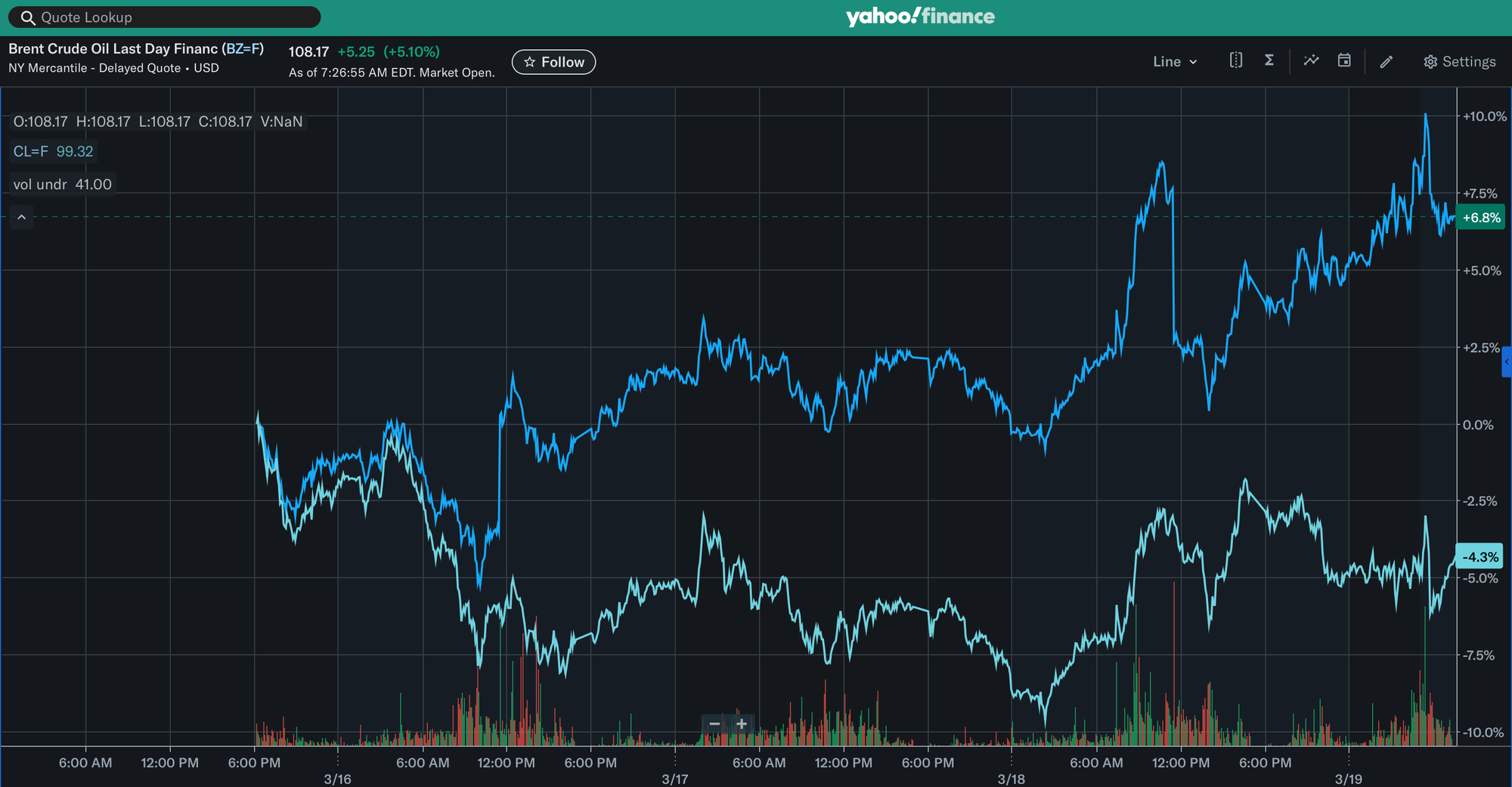
Brent, WTI: +6.48% ($114.34; crossed $119 overnight) / +1.29% ($97.57)
Copper: -2.96% | Gold: -4.25%
VIX: 25.66 (+0.57)
MOVING THE TAPE
Energy infrastructure attacks mark a new phase in the war.
Israel’s attack on Iran’s South Pars gas field and retaliatory missile strikes on Qatar’s Ras Laffan industrial complex by Iran have widened the conflict’s focus from shipping lanes to production assets. Additional drone and missile incidents targeting refineries and gas facilities across Saudi Arabia, the UAE, and Kuwait underscore the risk that supply losses may persist even after hostilities subside.
Oil and natural-gas markets surge on duration fears.
Brent crude briefly climbed above $119 per barrel overnight while European gas futures nearly doubled, reflecting anxiety over prolonged outages at critical LNG export hubs. The widening dislocation between global crude benchmarks and domestic US pricing highlights the extent to which the shock is centered in Middle Eastern export flows rather than North American supply.
Central banks pivot to caution after the Fed decision.
The Federal Reserve held rates steady while maintaining projections for only one cut this year, emphasizing uncertainty around how sustained energy price increases will influence inflation and employment. Policymakers across Europe and Asia face similar dilemmas as markets begin to price tighter policy trajectories in response to rising fuel costs. The BOJ kept rates unchanged on Thursday, but Governor Kazuo Ueda refused to rule out a potential April hike.
Policy mitigation efforts focus on domestic logistics.
The White House’s temporary waiver of the Jones Act is aimed at easing refined-product transport constraints within the United States, particularly between Gulf Coast refineries and East Coast demand centers. But the move is likely to only bring down east coast refined products prices by a few cents per gallon, and the move does little-to-nothing to address disruptions to global crude and LNG supply flows.
Industrial commodities weaken as growth risks intensify.
Copper’s sharp decline — completely erasing gains accumulated earlier in the year this morning — reflects rising concern that higher energy costs and supply chain disruptions will weigh on global manufacturing activity. Broader declines across metals markets reinforce the emerging view that the conflict is evolving into a macro growth shock rather than solely an inflationary one.
IMMEDIATE TELLS
- Rates markets are repricing persistent inflation risk. The rise in both 2y and 10y Treasury yields signals growing investor conviction that central banks will be slower to ease policy in the face of elevated energy prices. The move contrasts with earlier phases of the conflict when declining yields reflected expectations of growth damage dominating the inflation impulse.
- Equity weakness is concentrated outside the US. Sharp losses across Asian and European benchmarks make the point that those regions as more vulnerable to supply disruptions, particularly through natural gas exposure and higher reliance on Middle Eastern imports. US equity futures have been comparatively resilient, leaning on both the country's domestic energy production and policy mitigation efforts.
- Brent-WTI divergence underscores the global nature of the shock. The widening spread between international and US crude benchmarks highlights that market tightening is right now centered on export availability rather than underlying global demand.
- Copper’s reversal reflects mounting growth concerns. The metal’s slide into negative territory for the year — and nearly 5% under, at that — reinforces the view that industrial demand expectations are deteriorating as energy costs surge. It's another suggestion that markets are beginning to price not just higher inflation but also the potential for slowing economic momentum.
- Volatility remains elevated but contained. The VIX’s climb toward the mid-20s signals rising uncertainty without yet pointing to systemic financial stress. Options pricing suggests investors are hedging against prolonged disruption rather than preparing for an immediate liquidity event.
CENTRAL BANKS CONFRONT MORE PERSISTENT ENERGY SHOCK
On Wednesday, the US Federal Reserve left the fed funds rate unchanged at 3.5% to 3.75%, and maintained calls for one more rate cut this year. At the same time, the governors — and chair Jerome Powell especially — also signaled that the bar for easing has risen.
The meeting could arguably be called semi-hawkish: only Fed Governor Stephen Miran favored a cut, the median dot still showed only one cut in 2026 and one in 2027, and Powell stressed that after five years of above-target inflation, another oil shock could “cause trouble for inflation expectations” even as he defended what he called "mildly restrictive" policy. The chairman used the phrase “wait and see” four times in his press conference following the decision. Inflation revisions were also telling: the Fed forecast revisions of +0.1pp to 2026 GDP, +0.3pp to headline inflation, and +0.2pp to core inflation, while Powell emphasized that sticky inflation plus an oil shock argues for “greater caution” and slower movement in either direction.
Europe faces the same problem in harsher form because its economy is much more exposed to the Middle Eastern gas market — and prices on the Dutch exchange for gas futures are now soaring after the attacks in Qatar. Goldman Sachs economists expect the ECB’s new projections to show 2026 growth cut to 1.1% and 2026 headline inflation raised to 2.2%, with president Christine Lagarde likely to stress “uncertainty, optionality and the need for vigilance” rather than commit to hikes yet. In a more severe shock, Goldman says, euro-area growth could take a 0.7pp hit in year one while headline inflation rises 0.9pp. The investment bank's BOE preview makes the same basic point: before the latest escalation, the MPC likely would have cut, but Goldman now expects a 7-2 hold at 3.75% and delayed easing, while UK headline inflation runs at 2.7% by 2026Q3. The common message from the major central banks is not that hikes are imminent, but that the old easing path is no longer a safe assumption.
FROM TRANSIT DISRUPTION TO SYSTEMIC DAMAGE
LNG traffic through Hormuz has effectively halted, Ras Laffan’s restart timeline is “highly uncertain” and could run from weeks to months and, as Jefferies analysts note, LNG plants “do not restart instantaneously." Taken together, the tail of this conflict is only getting longer, especially for the gas market. Natural gas prices on the TTF are up roughly 93% over the past month and Europe is heading into refill season with storage at only about 29%, while Asian buyers are already paying up for replacement cargoes. The result is a much uglier setup for global gas balances through the rest of 2026 and potentially into 2027.
Problems are similar in the oil market. Three weeks into the conflict, flows through the Strait of Hormuz are still running about 97% below normal, and the estimated hit to Persian Gulf oil flows remains roughly 16.1 million barrels per day even after accounting for redirection through other routes, per Goldman Sachs' commodities desk. The physical market is also breaking away from the paper market. Dubai cash prices closed at $156 a barrel, roughly a $50 premium above futures, a sign of extreme tightness for prompt Middle Eastern crude. And even the supposed relief valves look limited. The Iraq-Turkey Kirkuk pipeline restart may help at the margin, but the near-term upside appears closer to 0.2 mb/d than anything game-changing.
The broader adjustment is already spreading. The crisis could delay Qatar’s North Field expansion from roughly 77 mtpa toward 142 mtpa, pushing expected new LNG supply deeper into the decade, per Jefferies. Rystad, meanwhile, argues that US shale isn't likely to ride to the rescue — a point I reported out last week. Producers are showing “strategic caution,” inventories are thin, and unless high prices last for months, operators are unlikely to materially revise plans, Rystad noted. In the market, that means the pressure is starting to sort winners from losers. Emerging markets strategists note the initial move was broad de-risking, but the longer the conflict runs, the more fundamentals take over: MSCI EM is down 8% since the war began, and oil importers are under increasingly high pressure.
Elsewhere...
In emerging markets, rising energy costs are beginning to pressure currencies and growth outlooks. Equity and FX benchmarks across energy-importing economies have weakened as investors reassess inflation trajectories and external balances. Policymakers are weighing fiscal responses such as fuel subsidies to cushion households and industry, but strategists warn prolonged intervention could strain already tight public finances.
In safe-haven markets, traditional defensive assets are behaving unevenly. Gold has fallen alongside equities in recent sessions, reflecting forced portfolio de-risking and rising real yields rather than a clean flight-to-quality dynamic. Analysts note that tighter global funding conditions and a firmer dollar are complicating the metal’s typical geopolitical bid.
In the energy sector, producers are signaling caution on new supply commitments. Research suggests US shale operators are unlikely to accelerate drilling materially unless elevated prices persist for several months, reinforcing the risk that global balances remain tight. The lack of a rapid supply response is adding to market concerns about the duration of the current shock.
Closing thoughts...
Markets are increasingly grappling with the realization that the Middle East conflict may represent more than a temporary disruption to energy flows. Damage to key infrastructure is pushing out a longer timeline for normalization, while central banks’ cautious response is tightening the financial backdrop. The combination raises the prospect that the shock will unfold not as a sudden crisis but as a gradual hit to growth momentum alongside persistent inflation pressures.
What matters is not just how high prices move, but how long the underlying constraints endure. As supply chains adjust, policy expectations reset, and industrial demand is increasingly affected by the strain of heightened energy costs, the shock's transmission is likely to ripple out more visibly across markets. The risk is that what began as a geopolitical supply event evolves into a broader macro regime shift defined less by acute volatility and more by sustained friction to the global system.