
Morning Brief | Mar. 20
Good morning, and welcome back to Clearing House.
Global markets are ending the week with a more coherent — and more dangerous — macro signal. What began as a supply shock centered on the Strait of Hormuz and Gulf energy infrastructure is now feeding directly into rates, currencies, and equity pricing in a way that looks increasingly stagflationary. Treasury yields are rising sharply, the dollar is firmer, global central banks are adopting a more openly hawkish tone, and equities are finally starting to absorb the possibility that this conflict will not resolve quickly enough to spare growth or margins.
The shift matters. Yesterday’s market still carried traces of a “wait and see” mentality, with investors trying to distinguish between temporary panic and lasting damage. This morning, that distinction is fading. With Qatar confirming a meaningful hit to LNG capacity, floating oil storage draining rapidly, and central banks from London to Frankfurt making clear they are prepared to respond to persistent inflation pressure, the shock is no longer just about missing barrels or missing cargoes. It is now about how long policymakers can remain patient — and how much of the global economy can absorb higher energy costs before the demand damage becomes visible.
MARKET READOUT (7:30 a.m. ET)
US 2-year, 10-year: +6.1bps (3.856%) / +4.8bps (4.297%)
DXY: +0.18% | USD/JPY: +0.51% | USD/CNH: +0.15%
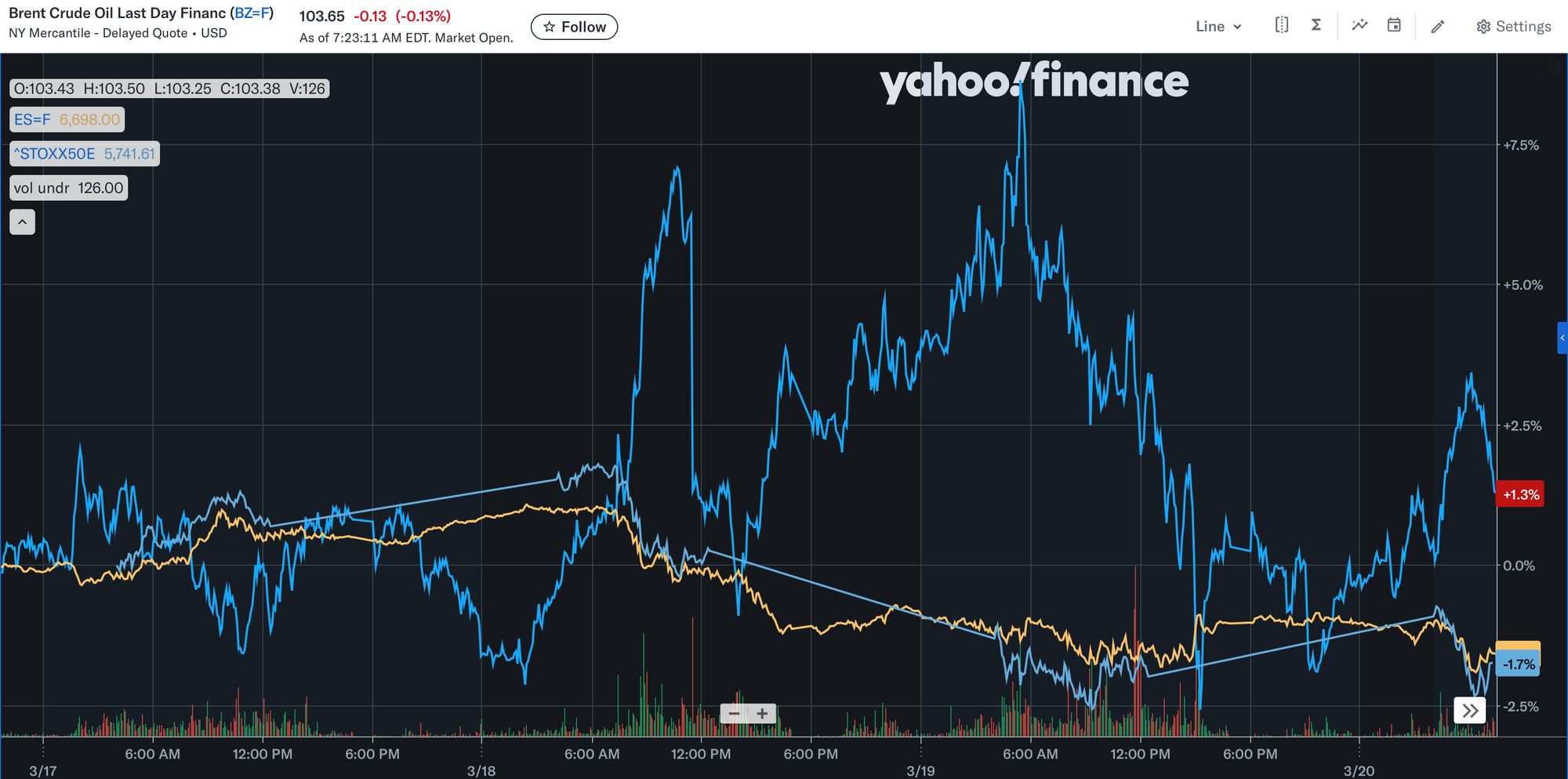
S&P Futures: -0.39% | Euro Stoxx: +0.23%
Nikkei: -3.38% at close | Kospi: +0.31% at close | Hang Seng: -0.88% at close
Brent, WTI: -0.13% ($108.50) / +0.34% ($96.47) | Copper: -0.02% | Gold: +1.24%
VIX: 24.82 (+0.76)
MOVING THE TAPE
Central banks can no longer pretend the Iran war is a temporary commodity spike.
The Bank of England, ECB, and other major central banks all held rates this week, yet each shifted toward a distinctly more hawkish direction as officials acknowledged the inflation risk of sustained energy disruption. ECB officials including Gabriel Makhlouf, Francois Villeroy de Galhau, and Joachim Nagel all kept the door open to hikes in press comments, while UK markets have aggressively repriced the BOE path toward an expectation of three rate hikes to come.
The rates shock is global, not just American.
UK government borrowing costs have surged to their highest levels since 2008, with the 10-year gilt near 4.93% and the 2-year up almost 100 basis points since the war began. That repricing reflects a broader market conclusion that the old easing path has been interrupted — and in some jurisdictions may be reversing.
Qatar’s LNG damage is forcing buyers into rationing behavior.
Asian buyers are pulling back as prices surge and physical availability worsens. Indian Oil reportedly declined to award an April cargo after bids came in near $28/mmbtu, Chinese buyers are stepping back where inventories allow, and Bangladesh is seeking roughly $2 billion in financing to secure LNG and other fuel imports ahead of summer demand.
Emergency oil buffers are thinning fast.
Floating storage, one of the market’s key shock absorbers, is being drawn down at one of the fastest rates seen in years as Persian Gulf supply remains constrained. The draw matters because it means the market is consuming its cushion at the same time that traders are confronting a conflict with no clear end state.
Equity investors are starting to lose faith in the “quick resolution” story.
The S&P 500 is now down 1.6% over the past two sessions, has slipped below its 200-day moving average, and is sitting at a four-month low. Desk commentary from Wall Street increasingly describes the market as split between those still looking for a quick end and those beginning to brace for either a correction or a slower 2022-style grind lower.
IMMEDIATE TELLS
- Rates are doing the clearest work this morning. A near-9 basis point rise in the 2-year and a 5 basis point move in the 10-year is not typical behavior for a market that thinks a shock is purely growth-negative and likely to fade quickly. Investors are repricing the risk that central banks stay restrictive for longer — and that in Europe and the UK, policymakers may need to tighten further.
- The dollar is reasserting itself as the pressure valve. A firmer USD alongside higher yields and softer risk assets fits the pattern of a stagflationary external shock. A stronger dollar tightens financial conditions, raises the import bill for energy-dependent economies, and reinforces the stagflationary mechanics already visible in rates.
- Brent-WTI is still sending the same message: this is a global seaborne supply shock. Brent is holding above $100 while WTI is, as of this morning, looking to end the week in the red. The disruption remains centered on seaborne export availability, shipping risk, and Middle Eastern physical balances rather than a generalized shortage of inland crude.
- Copper still looks like a growth signal. Even after Thursday’s washout, the metal remains heavy, which suggests industrial markets are focused less on cost-push inflation and more on the possibility that higher energy costs will begin to bite into manufacturing demand. When oil and yields are rising but copper cannot sustain a rally, the situation looks like a worsening growth/inflation mix rather than clean reflation.
CENTRAL BANKS ARE PRICING IN SECOND-ROUND EFFECTS
One of the most important developments of the past 24 hours: central banks are starting to treat the shock as durable enough to meaningfully shift their inflation outlooks. Goldman Sachs' European rates desk describes the ECB's messaging on Thursday as meaningfully more hawkish, noting that officials explicitly pointed to the potential need for tightening policy if the shock proves “larger or more protracted” than previously expected, and that an April move is now a meaningful possibility rather than a tail risk. The BOE struck a similar note: while the Governing Council held steady on Thursday, staff projections incorporated stronger pass-through expectations from energy into core inflation, and Goldman suggests anything from 50 to 75 basis points of tightening in the ECB’s adverse scenario and 100 to 175 basis points in a more severe outlook.
These shifts in policy outlook help explain the increasingly violent repricing in rates markets. Before the war, traders were pricing meaningful easing by the US Federal Reserve this year; that has nearly vanished, and Macquarie notes that a hike could be coming as soon as the first half of 2027. In Europe and the UK, the swing is more dramatic still because those economies are more exposed to imported energy and gas price transmission. UK yields are at post-2008 highs, gilts have suffered a near-100bp move at the front end since the war began, and the ECB is now openly discussing scenarios in which inflation reaccelerates even as growth slows. It's the exact policy bind investors and policymakers were hoping to avoid: a supply shock large enough to hurt growth, but persistent enough to keep central banks from riding to the rescue.
PHYSICAL BUFFERS ARE BURNING OFF
Data from Vortexa shows floating crude and condensate storage has been falling by roughly 1.8 million barrels per day since the war began, leaving around 78 million barrels on water — and about a third of what remains is Iranian, currently under strict sanctions from the US Treasury. Goldman Sachs estimates the overhang of Russian and Iranian oil on water at a combined 236 million barrels, yet noting that even a margin of that size would offset only about two weeks of disrupted flows through the Strait of Hormuz. In other words, the market is drawing down emergency inventory buffers while the main disruption remains largely unresolved, and that tightening is now visible in prompt physical pricing. Dubai and Oman FOB cargoes were trading near $158.85 per barrel this morning, more than $50 above Brent futures — an extraordinary dislocation that signals acute scarcity for immediately deliverable Middle Eastern crude.
That leaves prices extremely sensitive to duration. Goldman has argued that if depressed Hormuz flows keep the market focused on lengthier disruptions, Brent is likely to exceed its 2008 all-time high. But more important than the headline call is the historical logic behind it: across the five largest supply shocks of the past half century, Goldman estimates an average hit to production of 42% after four years, often because infrastructure damage and low investment prevent a clean return to pre-shock output — a shift investors are now seeing come to fruition in the Gulf.
LNG IS TRANSMITTING EARLY SIGNALS OF LASTING ECONOMIC DAMAGE
Oil dominates headlines, but the gas market may be the more important channel for global growth damage. Iran’s attacks on the Qatari Ras Laffan gas complex appear to have knocked out roughly 17% of Qatar’s LNG export capacity for three to five years, and it emphasizes that there are already visible signs of demand destruction in Asia: Indian buyers are balking at spot prices, Chinese buyers are stepping back where inventories allow, Bangladesh is trying to secure emergency financing for imports, and countries across Asia are turning back toward coal to fill the gap left by missing LNG.
UBS argued this week that the first phase of the shock is characterized by higher yields, a stronger dollar, weaker equities, and muted gold performance as markets focus on inflation. Only later, if energy prices stay high for longer, does the second phase emerge where growth concerns dominate. Once utilities, industrial buyers, and importing governments start rationing and substituting, borrowing, or backing away from spot purchases altogether, long-term damage becomes much more of a real potential.
Elsewhere...
In credit markets, strategists are warning that the macro mix is turning structurally more difficult. JPMorgan’s credit desk highlights that rising front-end yields alongside widening spreads removes the traditional diversification benefit bonds typically provide when equities weaken. The result is a more challenging environment in which both duration and credit beta can work against investors simultaneously. If energy prices remain elevated long enough to feed into earnings and refinancing risks, that configuration raises the probability of further spread decompression.
In Europe’s industrial sector, the energy shock is translating into tangible margin pressure. Sell-side research on heavy industry suggests that sustained gas prices in the €50-55/MWh range would materially erode profitability for energy-intensive sectors such as steel, chemicals, and refining unless hedges or policy offsets are put in place. The broader point is that the transmission mechanism is once again moving from commodity markets into real-economy cost structures — a shift that historically precedes weaker output and employment trends.
In Japan and Switzerland, policymakers are confronting opposite currency dynamics generated by the same shock. Japanese economists note that yen weakness combined with higher oil prices complicates the Bank of Japan’s timing on further tightening, even as domestic growth signals remain fragile. In contrast, the Swiss National Bank signaled this week an increased willingness to intervene in foreign exchange markets as safe-haven inflows push the franc higher. Taken together, the energy shock is reshaping global monetary conditions not only through inflation expectations but also through exchange rate channels.
Closing thoughts...
Markets are ending the week with a clearer grasp of the Gulf conflict's long tail risk. No longer just a story of blocked tankers, damaged terminals, or higher spot cargoes, the conflict is now looking like a supply shock large enough to lift inflation and colliding with a policy backdrop too cautious to simply look through it. Rates are rising, the dollar is stronger, equities are slipping, and pressure is showing up in importers, industrial users, and the front end of global curves.
The key question from here is whether the market remains in phase one — inflation repricing without a full growth break — or tips into phase two, where rationing, margin pressure, and weaker demand start to dominate. The longer Gulf energy flows stay impaired and the longer LNG shortages force substitution and fiscal scrambling, the harder it becomes to argue that markets are still dealing with a temporary geopolitical premium rather than a structural supply shock.