
Morning Brief | Mar. 9, 2026
Oil prices crossed $100 a barrel overnight for the first time since the early months of the Russia-Ukraine war as the conflict in the Middle East escalated over the weekend and supply disruptions deepened across the region. The move comes amid a series of shocks hitting the energy system simultaneously: attacks on infrastructure, production shut-ins in Iraq, tanker disruptions across the Persian Gulf, and a hardline leadership transition in Tehran after hardliner and IRGC ally Mojtaba Khamenei assumed power following the death of his father in the first round of US-Israeli airstrikes.
For markets, the surge arrives at a delicate moment. Economic data in the US has begun to show signs of labor market weakness, yet the inflation fight is likely to be complicated by the return of higher energy prices. The result is a familiar and uncomfortable setup: a geopolitical supply shock colliding with a slowing global economy — stagflation.
MARKET READOUT (7:20 a.m. ET)
US 2-year, 10-year: +5bps / -1.3bps
DXY: +0.27% | USD/JPY: +0.43% | USD/CNH: +0.31%
S&P Futures: -1.08% | Euro Stoxx: -2.07%
Nikkei: -5.2% at close | Kospi: -5.96% at close | Hang Seng: -1.35% at close
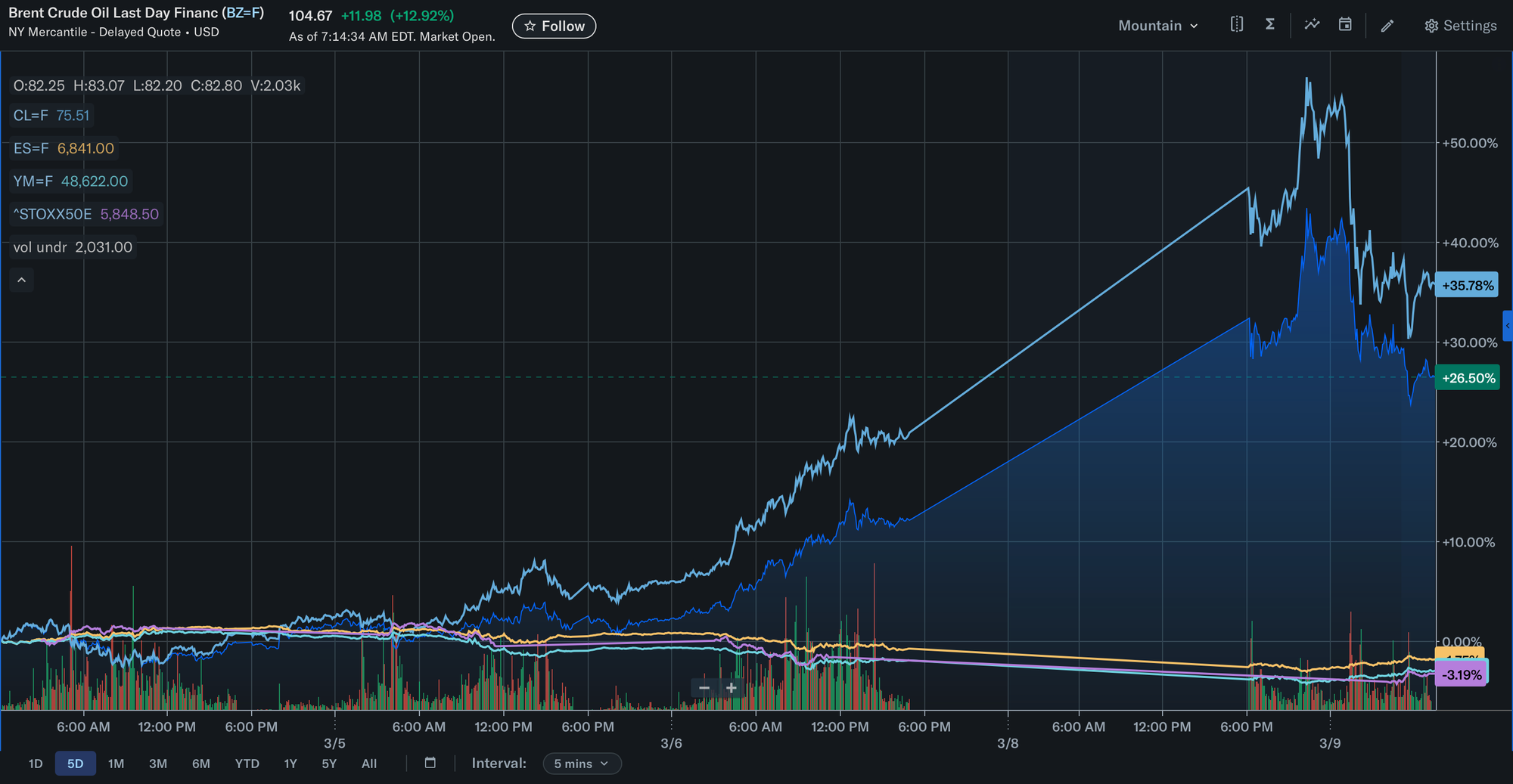
Brent, WTI: +12.8% ($104.55) / +12.79% ($102.53) | Copper: -0.87% | Gold: -1.15%
VIX: 31.71 (+2.22)
ON THE TAPE
Oil breaks through $100 as supply disruptions deepen.
Crude surged overnight, with Brent and WTI both cracking $119/bbl before pulling back to roughly $103 and $100, respectively. The move reflects mounting supply risks as production disruptions spread across Iraq, Kuwait, and Saudi Arabia, and tanker traffic through the Strait of Hormuz remains at a standstill.
Saudi Arabia begins curbing production as storage pressure mounts.
Saudi Arabia’s state oil giant Aramco has begun cutting output in at least two oil fields as the near-closure of the Strait of Hormuz disrupts exports, according to Reuters. The move signals that the shipping disruption is now forcing production cuts across multiple Gulf producers, not just Iraq, raising the risk that supply losses could deepen if tanker traffic does not resume.
Energy infrastructure increasingly under fire.
Strikes over the weekend targeted oil depots and energy facilities across Iran and the Gulf, setting major fuel storage sites ablaze near Tehran and damaging infrastructure tied to refining and distribution networks. The escalation signals that the conflict is moving beyond shipping disruptions into direct attacks on the energy system itself — a development threatening production, refining, and export capacity across the region.
Iran leadership succession signals potential hardline turn.
Mojtaba Khamenei was installed as Iran’s new Supreme Leader, a lifetime appointment, after the death of Ayatollah Ali Khamenei. The transition places a figure closely aligned with the Islamic Revolutionary Guard Corps at the center of power, raising the risk the conflict escalates rather than de-escalates.
Governments begin discussing emergency energy measures.
Officials from several major economies are considering coordinated releases from strategic petroleum reserves as the conflict threatens energy flows through the Persian Gulf, with a call among the G7 leaders scheduled for 8:30 a.m. ET. The discussions highlight growing concern that the disruption could evolve from a risk premium into a genuine supply shock — and raise questions of why the US administration didn't refill its own SPR over the past year while gas prices were low.
IMMEDIATE TELLS
- Bond markets are sending the clearest signals. Yields across major government bond markets have climbed steadily this week as central banks reconsider whether they will be able to cut interest rates if higher energy prices begin feeding into inflation again.
- Asian markets plunge on energy shock. Equity markets across Asia sold off sharply to close deep in the red, with Japan’s Nikkei and South Korea’s Kospi suffering some of the steepest losses globally as investors priced in the region’s heavy reliance on Middle Eastern energy imports.
- Volatility surges across global markets. The VIX jumped above 30 while Treasury yields moved higher as investors reassessed the inflation outlook. Traders pushed back expectations for Federal Reserve rate cuts as the oil spike revived fears of renewed price pressures.
- The dollar is strengthening as investors move toward safety. Currency markets are tilting toward the dollar as investors pull back from risk assets and energy-importing economies come under pressure. Historically, geopolitical shocks that drive oil higher tend to strengthen the dollar as global liquidity tightens.
ENERGY SUPPLY
The conflict in the Middle East only intensified over the weekend as the Strait of Hormuz — the single most critical chokepoint in the global energy system, carrying roughly a fifth of global oil flows and large volumes of liquefied natural gas — remains effectively closed. Shipping data shows tanker traffic through the strait has slowed to a near standstill for several consecutive days as insurers raise premiums and vessel operators avoid the route.
Pushing oil prices higher, major producers are increasingly moving toward shut-ins. When exports are blocked, crude accumulates in storage tanks near production sites. Once storage capacity fills, producers are forced to shut in wells — effectively removing supply from the global market until shipments can resume. Iraq has already cut roughly 60% of its production capacity as export routes remain constrained, while Kuwait and the United Arab Emirates have also reduced output, And in the latest crucial news, Saudi Arabia — the world's second largest oil producer — has now begun curbing production as well. State oil giant Aramco has started cutting output at several oilfields while rerouting some shipments toward the Red Sea export terminal at Yanbu, according to Reuters.
The same dynamic is beginning to ripple into natural gas markets. LNG exporters in the Persian Gulf ship large volumes of cargo through the Strait of Hormuz, and sustained disruption is forcing buyers in Europe and Asia to compete for alternative supplies. Gas markets have already reacted sharply, with European benchmark prices jumping and traders scrambling to secure replacement cargoes.
GLOBAL RATES
The oil surge lands just days before a crucial stretch of US inflation data that will help determine how markets interpret the shock. Consumer price index data is due Wednesday, followed by the Federal Reserve’s preferred inflation gauge — the personal consumption expenditures index — later in the week. While both reports largely reflect data collected before the most recent escalation in the Middle East, they will provide the baseline against which the coming energy shock will be measured.
The timing complicates the outlook for monetary policy. Friday’s payroll report showed the US economy lost 92,000 jobs on the month, raising concerns that the labor market may finally be slowing after several years of resilience. Outside factors played a role in the print — a major healthcare labor strike, severe winter weather, etc. — but the report still came in far below expectations of roughly 55,000 jobs added.
Under normal circumstances, softer labor market data would strengthen the case for Federal Reserve rate cuts later this year. But a renewed surge in energy prices complicates that picture. Higher oil prices lift inflation even as they weaken economic activity — the stagflationary combination that tends to delay interest-rate cuts rather than accelerate them. Goldman Sachs analysts estimate that oil sustained around $100 a barrel could push global headline inflation roughly 0.7 percentage points higher while shaving about 0.4 percentage points off global growth. Markets continue to price one to two quarter-point rate cuts by the end of the year in the United States, but expectations have already begun to shift as oil prices climb.
Outside the United States, the repricing is more dramatic. Traders are pricing in additional tightening in parts of Europe, and economists warn that sustained energy prices could push UK inflation back toward 5% later this year. The result is a rapidly shifting global policy outlook in which central banks may find themselves forced to keep borrowing costs higher for longer even as growth weakens.
ECONOMIC RIPPLES
The economic consequences of the shock are uneven. Asia is the most immediately exposed, as countries such as Japan, South Korea, and India rely heavily on oil and gas shipments passing through the Persian Gulf, leaving their economies particularly vulnerable to disruptions in the Strait of Hormuz. Vis-a-vis, Asian buyers are now scrambling to secure alternative fuel supplies, with several tankers that had originally been bound for Europe recently rerouted toward East Asia as importers bid aggressively for cargoes. Governments across the region are also weighing emergency policy responses as higher oil prices threaten to widen trade deficits and push inflation higher.
Europe faces a different but related vulnerability. Although the region has diversified away from Russian energy since 2022, European gas markets remain fragile. Storage levels are well below seasonal averages and LNG imports from the Gulf remain an important part of the continent’s supply balance. That combination means sustained disruptions in Gulf energy flows could quickly ripple through global shipping networks, power markets, and industrial supply chains. TTF futures were up 17% around 7 a.m. ET.
Emerging markets may feel the pressure first through currencies and bond markets. Higher energy prices tend to widen trade deficits for energy-importing economies while strengthening the dollar, tightening financial conditions globally. South African government bond yields have already surged as investors price out expectations of interest-rate cuts and begin positioning for potential rate increases if inflation accelerates.
Elsewhere...
In Europe, the euro has already weakened as oil prices surge, reviving memories of the inflation spike that followed Russia’s invasion of Ukraine. With markets now beginning to price the possibility of additional tightening from the European Central Bank and Bank of England, the region could once again face the familiar combination of weaker growth and higher prices.
In emerging markets, currency markets are showing early stress as energy-importing economies weaken under the weight of rising oil prices. Egypt’s pound posted its biggest one-day drop in years to hit a record low (52.8 E£/USD) while other import-dependent economies across Asia and Africa are facing rising pressure on trade balances and subsidy budgets.
In equity markets, investors are rapidly turning more defensive. Hedge funds sharply increased short positions in US equity exchange-traded funds last week, according to Bloomberg citing Goldman Sachs prime brokerage data — one of the fastest buildups in bearish positioning in several years. The shift suggests investors are preparing for further volatility as rising oil prices revive concerns about inflation, growth, and the durability of the global equity rally.
Closing thoughts...
Over the past ten days, markets have moved from pricing a geopolitical risk premium to confronting a genuine supply shock. What began as a disruption to shipping routes in the Persian Gulf is now beginning to affect production itself, as storage constraints force major exporters to curtail output. And this all comes as the global economy was already entering a fragile moment. Growth in several major economies had begun to slow, and central banks were only starting to contemplate easing policy after two years of aggressive tightening. A sustained energy shock now threatens to complicate that trajectory by pushing inflation higher just as activity begins to soften.
For investors and policymakers alike, the key variable is duration. Short disruptions tend to produce sharp but temporary spikes in commodity prices. Prolonged interruptions, however, can reshape supply chains, tighten fuel markets, and feed through into transportation, electricity, and industrial costs across the global economy. For now, markets are attempting to price both possibilities at once. But if tanker traffic through the Strait of Hormuz remains constrained and production cuts continue to spread across Gulf exporters, the question facing markets will shift from how high oil prices can go to how long the global economy can absorb them.